Promise to My Wife and Children Never Have a Drink Again
Over my 25 years of experience as a psychologist, I gradually came to realize that drinking may exist one of the well-nigh mutual withal to the lowest degree talked about causes of marital conflict. Unfortunately, in the couples I've worked with this event is ofttimes swept under the carpet. And when it does arise it ordinarily devolves quickly into a scenario something like the post-obit:
"You're an alcoholic."
"No, I'chiliad not."
"Yes, you lot are!"
"No, I'yard not!"
Needless to say, this kind of interaction leads to nothing other than perchance anger and alienation between spouses. For some it can exist tantamount to marital Armageddon. Sadly, this does not have to be expressionless finish information technology and so frequently is. The reason why this scene is so mutual -- and futile -- has to do in part with the manner society (and health professionals) have traditionally viewed drinking issues, which is as a dichotomy, equally represented by the diagram beneath.
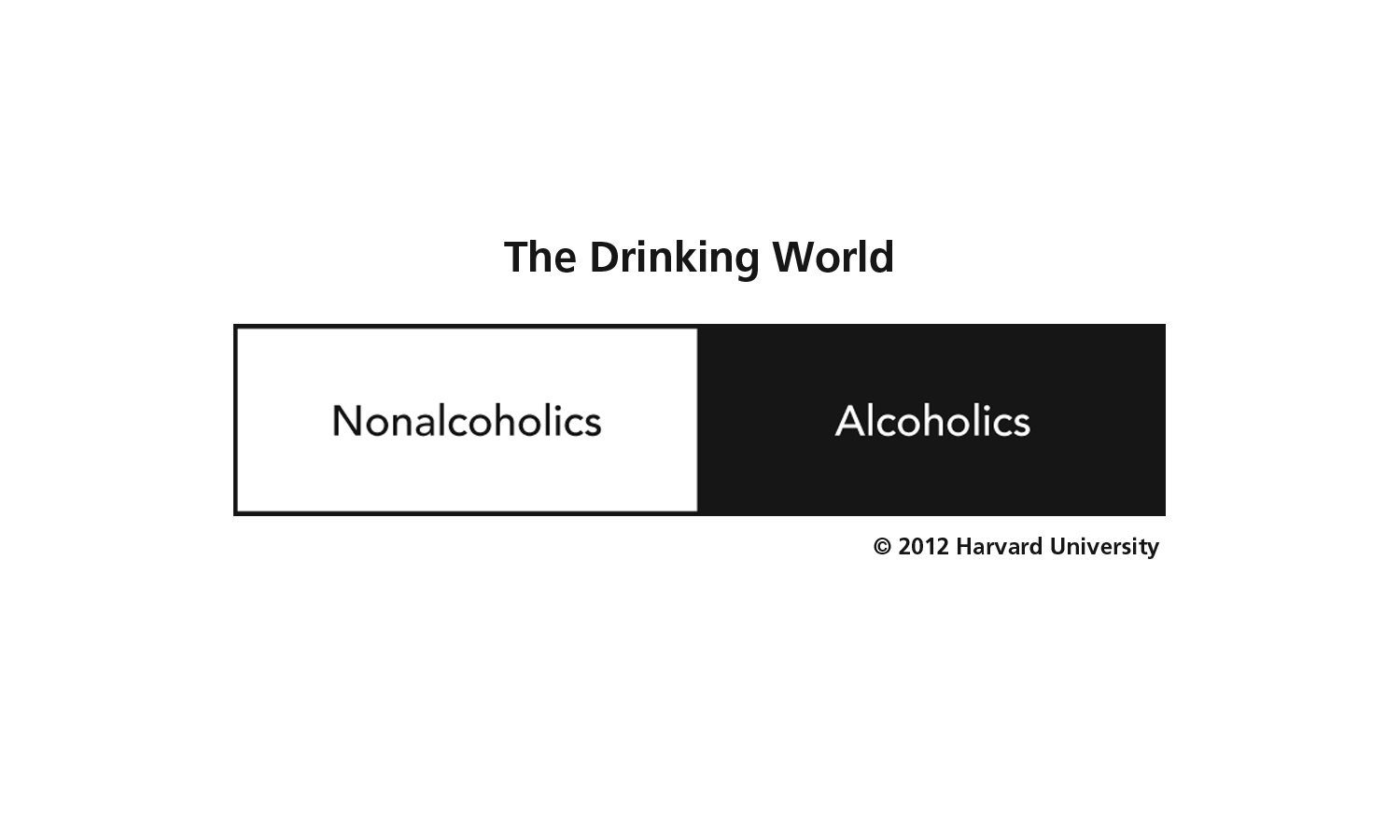
Viewed from this perspective, the "drinking world" is neatly divided into ii mutually exclusive categories: alcoholics, and the rest of usa. But is this reality? No, it is not. In fact, while drinking does contribute mightily to marital issues, the vast bulk of men and women who have what might exist termed a "drinking problem" are not alcoholics. Rather, they fall somewhere in the near alcoholic zone that is depicted in the following diagram.
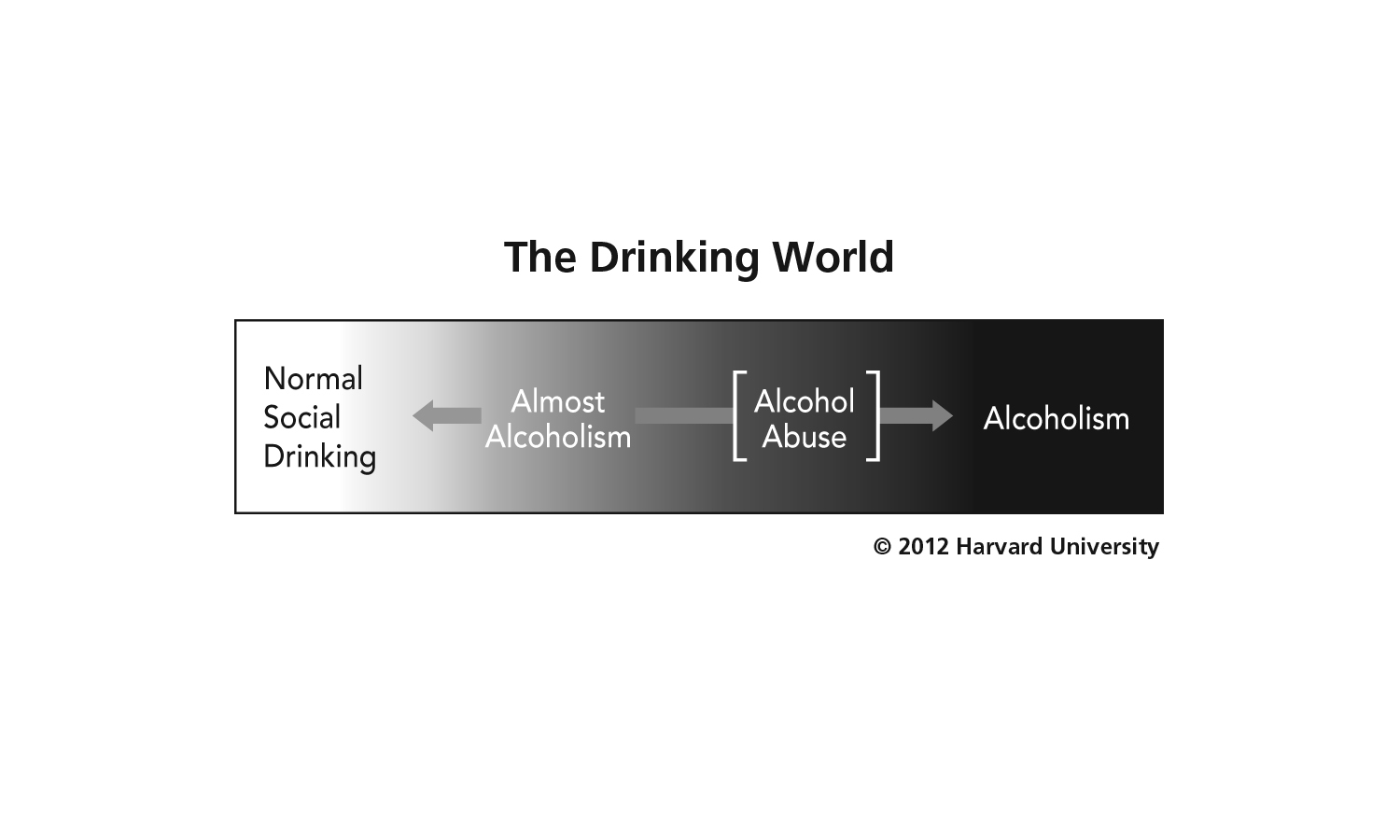
From this perspective the drinking globe is a spectrum as opposed to a dichotomy. And as yous can see the nigh alcoholic zone is fairly big, and even inside that zone there are varying degrees. In other words, a person may take merely recently made the movement from what I telephone call "normal social drinking" into the "most-alcoholic" zone; alternatively, they may take been living fairly deep in this zone for years, even so notwithstanding not meet the criteria for a diagnosis of alcoholism.
The greatest chance of living in the almost-alcoholic zone is that people may not "connect the dots" (or want to connect the dots) between their drinking behavior and its consequences, including its consequences on their relationships. Beingness an almost alcoholic can near definitely, however, take effects on our health, our emotions, and our power to realize our potential equally workers, parents, and spouses.
A New Approach
If you hold that it gets nowhere to get into a "diagnostic standoff" as described above, and then here are some suggestions for addressing this issue more effectively:
Avoid the "A" and "D" Words
Calling someone an alcoholic has a nearly 100 per centum chance of getting their hackles upward. Despite the fact that there is less stigma associated with alcoholism today than there in one case was, it is still a clinical diagnosis -- and an unflattering one. Aside from that, most men and women who are experiencing drinking-related consequences fall somewhere in the nearly-alcoholic zone. It's ameliorate to exit a diagnosis of alcoholism to qualified professionals and keep it out of a marital dialogue.
The same dominion applies to the "D" word: deprival. For years it was popular amidst alcoholism counselors to declare that any clients of theirs who expressed dubiousness that they were alcoholics were in "deprival," in other words, refusing to face the truth and admit information technology. This kind of confrontation undoubtedly led to many people dropping out of handling, refusing to attend even a single AA meeting, or both. A spouse who asserts that his or her partner is in denial is again likely to engender nothing more than resentment, followed by little if whatever change.
Don't Talk About Forever
I wish I had even a nickel for every human being and woman who woke upwardly after getting boozer and alleged that he or she would never drink again! I'd be a rich man indeed. Spouses who try to become a commitment from their drinking partner never to potable over again are usually asking someone to brand a hope they can't keep. Again, that sets the phase for disappointment and farther conflict. The fact is that just the individual tin can make the determination that drinking is out of control and that the pursuit of forbearance is their best option. For all those millions of men and women who are in the almost-alcoholic zone, it may be quite possible to reverse course and "shift left" on the drinking spectrum.
Connect the Dots
Rather than do any of the above, a more successful arroyo is simply and thing-of-factly point out the connexion between your partner'due south drinking and its consequences. These consequences can exist physical, behavioral, and/or psychological. Here are a few very common examples:
• "Have yous noticed that over the past vi months or so you lot tend to fall asleep early the couch after having your evening drinks?"
• "You've been waking up in the eye of the night and having a hard time getting back to slumber. Have you noticed that that's been happening ever since you increased your drinking?"
• "I noticed that yous've cut way back on your exercising since y'all started having three or 4 glasses of wine every dark."
• "You say that you've been feeling kind of depressed and tired. That seems to have gotten worse every bit you've been drinking more."
• "Practice yous retrieve your dr.'southward concerns well-nigh your blood force per unit area going upwards could be connected to the fact that your drinking has increased over the by year?"
Accept "Progress Over Perfection"
Fifty-fifty for true alcoholics who come to the conclusion that drinking has made their lives unmanageable and that they must give it upwardly, modify is typically hard. AA has long recognized this, and while it celebrates the private who has years of unbroken sobriety it also celebrates the individual who has days or weeks of sobriety. Again, spouses need to avoid seeking promises that are unlikely to be kept. Better to say something positive to the spouse who has had several drinks a mean solar day for years, simply who for the past calendar month has had more sober days than drinking days, and who drinks less on those days when he or she does drink.
Meeting Halfway
The above approach is much more than likely to create a bond between spouses than a confrontational approach or ane that seeks perfection over progress. Information technology represents a collaborative effort that can pb to very positive modify, especially for all those men and women who occupy the near-alcoholic zone.
For more by Joseph Nowinski, Ph.D., click here.
For more on habit and recovery, click here.
Source: https://www.huffpost.com/entry/alcohol-abuse-relationships_b_3076888
0 Response to "Promise to My Wife and Children Never Have a Drink Again"
إرسال تعليق