what kind of jazz attempted to merge rock and jazz?
| Jazz fusion | |
|---|---|
 | |
| Stylistic origins |
|
| Cultural origins | Late 1960s, U.s. |
| Derivative forms |
|
| Other topics | |
| List of musicians | |
Jazz fusion (also known as fusion [2] and progressive jazz [three]) is a music genre that developed in the belatedly 1960s when musicians combined jazz harmony and improvisation with rock music, funk, and rhythm and blues. Electric guitars, amplifiers, and keyboards that were popular in rock and roll started to be used by jazz musicians, particularly those who had grown up listening to stone and scroll.
Jazz fusion arrangements vary in complexity. Some employ groove-based vamps fixed to a unmarried primal or a unmarried chord with a simple, repeated tune. Others apply elaborate chord progressions, unconventional time signatures, or melodies with counter-melodies. These arrangements, whether simple or circuitous, typically include improvised sections that can vary in length, much similar in other forms of jazz.
As with jazz, jazz fusion can utilize brass and woodwind instruments such equally trumpet and saxophone, but other instruments often substitute for these. A jazz fusion ring is less probable to apply piano and double bass, and more than likely to apply electric guitar, synthesizers, and bass guitar.
The term "jazz rock" is sometimes used every bit a synonym for "jazz fusion" and for music performed by belatedly 1960s and 1970s-era rock bands that added jazz elements to their music. After a decade of popularity during the 1970s, fusion expanded its improvisatory and experimental approaches through the 1980s in parallel with the evolution of a radio-friendly style called smooth jazz.[4] Experimentation continued in the 1990s and 2000s. Fusion albums, even those that are made by the same grouping or artist, may include a diversity of musical styles. Rather than beingness a codified musical fashion, fusion tin can exist viewed as a musical tradition or approach.
History [edit]
Coryell and two worlds [edit]
When John Coltrane died in 1967, rock was the most popular music in America, and DownBeat mag went so far every bit to declare in a headline that: "Jazz as Nosotros Know It Is Dead".[5]
Guitarist Larry Coryell, sometimes called the godfather of fusion, referred to a generation of musicians who had grown up on rock and whorl when he said, "Nosotros loved Miles but we likewise loved the Rolling Stones."[6] In 1966 he started the band the Costless Spirits with Bob Moses on drums and recorded the ring'southward kickoff anthology,[five] Out of Sight and Sound, in 1967. That aforementioned year DownBeat began to report on rock music.[half-dozen] After the Free Spirits, Coryell was part of a quartet led by vibraphonist Gary Burton, releasing the album Duster with its rock guitar influence.[5] Burton produced the album Tomorrow Never Knows for Count's Jam Ring, which included Coryell, Mike Nock, and Steve Marcus, all of them former students at Berklee College in Boston.[v]
The pioneers of fusion emphasized exploration, energy, electricity, intensity, virtuosity, and book. Charles Lloyd played a combination of rock and jazz at the Monterey Jazz Festival in 1966 with a quartet that included Keith Jarrett and Jack DeJohnette.[vi] Lloyd adopted the trappings of the California psychedelic rock scene by playing at the rock venue the Fillmore West, wearing colorful clothes, and giving his albums titles like Dream Weaver and Forest Flower, which were bestselling jazz albums in 1967.[v] Flautist Jeremy Steig experimented with jazz in his ring Jeremy & the Satyrs with vibraphonist Mike Mainieri. The jazz label Verve released the first album (Freak Out) by stone guitarist Frank Zappa in 1966.[6] Rahsaan Roland Kirk performed with Jimi Hendrix at Ronnie Scott's Jazz Club in London.[6]
AllMusic states that "until around 1967, the worlds of jazz and stone were nearly completely separate".[vii]
Miles Davis plugs in [edit]
Every bit members of Miles Davis's band, Chick Corea and Herbie Hancock played electrical piano on Filles de Kilimanjaro. Davis wrote in his autobiography that in 1968 he had been listening to Jimi Hendrix, James Brownish, and Sly and the Family unit Stone.[half dozen] When Davis recorded Bitches Brew in 1969, he mostly abandoned the swing trounce in favor of a rock and roll backbeat and bass guitar grooves. The anthology "mixed costless jazz blowing by a big ensemble with electronic keyboards and guitar, plus a dense mix of percussion."[8] Davis played his trumpet like an electric guitar—plugged in to electronic effects and pedals.
By the end of the get-go year, Bitches Mash sold 400,000 copies, four times the average for a Miles Davis album. Over the adjacent two years the aloof Davis recorded more oftentimes, worked with many sidemen, appeared on goggle box, and performed at rock venues. Simply every bit quickly, Davis tested the loyalty of rock fans by standing to experiment. His producer, Teo Macero, inserted previously recorded material into the Jack Johnson soundtrack, Live-Evil, and On the Corner.[9]
Although Bitches Brew gave him a gold record, the employ of electric instruments and rock beats created consternation among some jazz critics, who defendant Davis of betraying the essence of jazz.[x] Music critic Kevin Fellezs commented that some members of the jazz customs regarded rock music as less sophisticated and more commercial than jazz.[11]
Davis's 1969 album In a Silent Way is considered his start fusion anthology.[12] Composed of two side-long improvised suites edited heavily by Teo Macero, the anthology was made by pioneers of jazz fusion: Corea, Hancock, Tony Williams, Wayne Shorter, Joe Zawinul, and John McLaughlin.
A Tribute to Jack Johnson (1971) has been cited as "the purest electric jazz tape ever fabricated" and "ane of the most remarkable jazz rock discs of the era".[13] [14]
According to music announcer Zaid Mudhaffer, the term "jazz fusion" was coined in a review of Vocal of Innocence by David Axelrod when it was released in 1968.[15] Axelrod said Davis had played the album earlier conceiving Bitches Mash.[sixteen]
Davis sidemen branch out [edit]
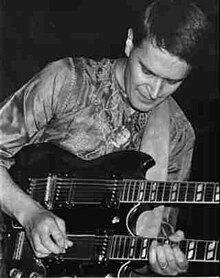
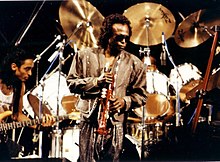
Miles Davis was one of the showtime jazz musicians to comprise jazz fusion into their cloth. His guitar player John McLaughlin branched out, forming his own fusion group Mahavishnu Orchestra. Blending Indian classical music, jazz, and psychedelic stone, they created a whole new style just as Davis had. Davis'south alive albums during this menses, including Live-Evil and Miles Davis at Fillmore, featured McLaughlin.
Davis dropped out of music in 1975 considering of problems with drugs and alcohol, but his sidemen took advantage of the creative and financial vistas that had been opened. Herbie Hancock brought elements of funk, disco, and electronic music into commercially successful albums such as Head Hunters (1973) and Feets, Don't Fail Me Now (1979). Several years after recording Miles in the Heaven with Davis, guitarist George Benson became a vocalist with plenty popular hits to overshadow his earlier career in jazz.[9]
While Davis was sidelined, Chick Corea gained prominence. In the early 1970s Corea combined jazz, rock, pop, and Brazilian music in Return to Forever, a band which included Stanley Clarke on bass guitar and Al DiMeola on electric guitar. Corea divided the residuum of his career betwixt audio-visual and electric music, non-commercial and commercial, jazz and popular rock, with a band for each: the Akoustic Ring and the Elektric Band.[9]
Tony Williams was a member of Davis's band since 1963. Williams reflected, "I wanted to create a dissimilar atmosphere from the one I had been in...What amend way to do information technology than to go electrical?" He left Davis to grade the Tony Williams Lifetime with English guitarist John McLaughlin and organist Larry Young. The band combined rock intensity and loudness with jazz spontaneity. The debut album Emergency! was recorded iii months before Bitches Brew.[6] [17] [18]
Although McLaughlin had worked with Miles Davis, he was influenced more past Jimi Hendrix and had played with English rock musicians Eric Clapton and Mick Jagger before creating the Mahavishnu Orchestra around the same fourth dimension that Corea started Return to Forever. McLaughlin had been a fellow member of Tony Williams's Lifetime. He brought to his music many of the elements which interested other musicians in the 1960s and early 1970s: counterculture, stone and ringlet, electronic instruments, solo virtuosity, experimentation, the blending of genres, and an involvement in the exotic, such as Indian music.[9] He formed the Mahavishnu Orchestra with drummer Billy Cobham, violinist Jerry Goodman, bassist Rick Laird, and keyboardist Jan Hammer. The band released its showtime album, The Inner Mounting Flame, in 1971. Hammer pioneered the use of the Minimoog synthesizer with baloney effects. His use of the pitch bend cycle fabricated a keyboard sound similar an electrical guitar. The Mahavishnu Orchestra was influenced past both psychedelic rock and Indian classical music. The band's starting time lineup broke up later on two studio albums and one live anthology, but McLaughlin formed another group in 1974 under the same name with jazz violinist Jean-Luc Ponty, one of the first electric violinists. During the late '70s, Lee Ritenour, Stuff, George Benson, Spyro Gyra, the Crusaders, and Larry Carlton[19] released fusion albums.
Inspirations [edit]
Jazz fusion formed in the tardily 1960s when musicians combined styles such as jazz, funk, rock, and R&B (rhythm and blues). It has been popularized past artists like Miles Davis, Herbie Hancock, Chick Corea, Pat Metheny, Wayne Shorter, and Allan Holdsworth, along with many other legends in the jazz world. Jazz and stone music take played an integral part in society throughout the 1960s and 1970s. Jazz populated the airwaves throughout the 1940s and 1950s with artists like Charlie Parker, Empty-headed Gillespie, and Thelonious Monk. Jazz of the 1940s was unremarkably referred to as bebop, which is characterized by fast tempo, complex chord progressions, and numerous central changes. In 1959 the quantum jazz record Kind of Blue was recorded by the great Miles Davis. This record has been described equally the "greatest jazz record of all time". Davis recorded it with pianist Bill Evans, saxophonists John Coltrane and Julian "Cannonball" Adderley, bassist Paul Chambers, and drummer Jimmy Cobb. This was the first modal jazz tape and shaped the sound for jazz of the 1960s and 1970s. For this record Miles Davis brought sketches to the studio with no sheet music, simply telling the musicians to play what they feel and listen to each other. While the record was improvised and loosely sketched, it has sold millions of copies and has go a remarkable staple in the jazz customs. Some modal jazz and/or jazz fusion records that followed were Bitches Brew, Head Hunters, Birds of Fire, and In a Silent Fashion.
Jazz rock [edit]
| Jazz-rock | |
|---|---|
| Stylistic origins |
|
| Typical instruments |
|
| Derivative forms |
|
The term "jazz-stone" (or "jazz/stone") is sometimes used as a synonym for "jazz fusion". The Free Spirits have sometimes been cited as the primeval jazz rock ring.[20]
Rock bands such equally IF, Colosseum, Chicago, Blood, Sweat & Tears, Soft Machine, Nucleus, Brand X, and the Mothers of Invention blended jazz and rock with electric instruments.[21] Davis' fusion jazz was "pure melody and tonal color",[21] while Frank Zappa's music was more than "complex" and "unpredictable".[22] Zappa released the solo album Hot Rats in 1969.[23] The anthology contained long instrumental pieces with a jazz influence.[24] [25] Zappa released two albums, The Grand Wazoo and Waka/Jawaka, in 1972 which were influenced past jazz. George Knuckles and Aynsley Dunbar played on both. 1970s band Steely Dan has been lauded by music critic Neil McCormick for their "smooth, smart jazz-rock fusion."[26]
The jazz artists of the 1960s and 1970s had a large impact on many rock groups of that era such equally Santana and Frank Zappa. They took jazz phrasing and harmony and incorporated information technology into modern stone music, significantly changing music history and paving the way for artists that would follow in their footsteps. Carlos Santana in detail has given much credit towards Miles Davis and the influence he had on his music. While Miles Davis combined jazz with modal and rock influences, Carlos Santana combined these forth with Latin rhythms and experience, shaping a whole new genre, Latin rock. Other rock artists such as Led Zeppelin, Gary Moore, The Grateful Dead, The Doors, Jimi Hendrix, and The Allman Brothers Band have taken influences from jazz and jazz fusion and incorporated it into their own music, taking various rhythms, instrumentation, musical theory, and soundscapes from the jazz realm and bringing it into stone music and all that it had to offer.
According to AllMusic, the term jazz rock "may refer to the loudest, wildest, most electrified fusion bands from the jazz military camp, merely virtually frequently it describes performers coming from the stone side of the equation...jazz rock get-go emerged during the late '60s as an effort to fuse the visceral power of stone with the musical complexity and improvisational fireworks of jazz. Since rock often emphasized directness and simplicity over virtuosity, jazz rock generally grew out of the most artistically aggressive rock subgenres of the late '60s and early '70s: psychedelia, progressive rock, and the singer-songwriter movement."[27]
According to jazz writer Stuart Nicholson, jazz rock paralleled complimentary jazz by existence "on the verge of creating a whole new musical language in the 1960s". He said the albums Emergency! (1969) by the Tony Williams Lifetime and Agharta (1975) by Miles Davis "suggested the potential of evolving into something that might eventually ascertain itself as a wholly contained genre quite apart from the sound and conventions of anything that had gone earlier." This evolution was stifled past commercialism, Nicholson said, every bit the genre "mutated into a peculiar species of jazz-inflected pop music that eventually took upwards residence on FM radio" at the end of the 1970s.[28]
In the 1970s, American fusion was being combined in the U.Chiliad. with progressive rock and psychedelic music. Bands who were part of this movement included Brand X (with Phil Collins of Genesis), Bruford (Bill Bruford of Yes), Nucleus (led past Ian Carr), and Soft Motorcar. Throughout Europe and the earth this movement grew due to bands like Magma in France, Passport in Germany, Leb i Sol and September in Yugoslavia, and guitarists January Akkerman (The netherlands), Volker Kriegel (Frg), Terje Rypdal (Norway), Jukka Tolonen (Finland), Ryo Kawasaki (Nippon), and Kazumi Watanabe (Japan).[half-dozen]
Jazz metal [edit]
| Jazz metal | |
|---|---|
| Stylistic origins |
|
| Typical instruments |
|
| Other topics | |
| |
Jazz metal is the fusion of jazz fusion and jazz rock with heavy metal. The genre is closely related to mathcore, progressive metal, and punk jazz, as well as its microgenres. Rollins Band has been known to combine heavy metal with jazz,[29] and starting in the late 1990s, King Crimson began to explore industrial metallic, blended with their progressive stone sound. Similarly, Animals equally Leaders' albums The Joy of Motion (2014) and The Madness of Many (2016) have been described as progressive metal combined with jazz fusion.[30]
Polish jazz [edit]

Past the early 1980s, much of the original fusion genre was subsumed into other branches of jazz and rock, especially smooth jazz, a radio-friendly subgenre of fusion which is influenced by R&B, funk, and popular music.[31] Smooth jazz tin be traced to at least the late 1960s, when producer Creed Taylor worked with guitarist Wes Montgomery on three popular music-oriented albums. Taylor founded CTI Records and many established jazz performers recorded for CTI, including Freddie Hubbard, Chet Bakery, George Benson, and Stanley Turrentine. Albums nether Taylor's guidance were aimed at both pop and jazz fans.
The merging of jazz and pop/stone music took a more than commercial management in the late 1970s and early 1980s, in the form of compositions with a softer sound palette that could fit comfortably in a soft stone radio playlist. The AllMusic guide's article on fusion states that "unfortunately, as information technology became a coin-maker and as stone declined artistically from the mid-'70s on, much of what was labeled fusion was actually a combination of jazz with easy-listening pop music and lightweight R&B."[7]
Michael and Randy Brecker produced funk-influenced jazz with soloists.[32] David Sanborn was considered a "soulful" and "influential" vox.[32] However, Kenny M was criticized past both fusion and jazz fans, and some musicians, while having become a huge commercial success. Music reviewer George Graham argues that the "and so-called 'smooth jazz' sound of people like Kenny G has none of the burn down and creativity that marked the best of the fusion scene during its heyday in the 1970s."[33]
Other styles [edit]
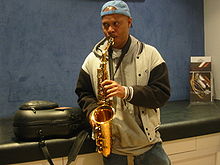
Steve Coleman in Paris, July 2004
In the 1990s, another kind of fusion took a more hardcore approach. Beak Laswell produced many albums in this motility, such equally Ask the Ages past avant-garde guitarist Sonny Sharrock and Arc of the Testimony with Laswell's ring Arcana. Niacin (band) was formed by rock bassist Baton Sheehan, drummer Dennis Chambers, and organist John Novello.[6]
In London, The Pop Group began to mix gratis jazz and reggae into their grade of punk rock.[34] In New York City, no wave was inspired by free jazz and punk. Examples of this style include Lydia Lunch'due south Queen of Siam,[35] James Chance and the Contortions, who mixed soul music with free jazz and punk stone, and the Lounge Lizards,[35] the first group to call themselves punk jazz.[35]
John Zorn took annotation of the emphasis on speed and dissonance that was becoming prevalent in punk rock and incorporated them into costless jazz with the release of the Spy vs Spy anthology in 1986. The album was a collection of Ornette Coleman tunes played in the thrashcore fashion.[36] In the same yr, Sonny Sharrock, Peter Brötzmann, Pecker Laswell, and Ronald Shannon Jackson recorded the first album under the name Last Get out, a alloy of thrash and free jazz.[37]
M-Base ("macro-basic array of structured extemporization") centers on a movement started in the 1980s. It started as a group of young African-American musicians in New York which included Steve Coleman, Greg Osby, and Gary Thomas developing a complex but grooving sound.[38] In the 1990s nearly M-Base participants turned to more conventional music, only Coleman, the about active participant, connected developing his music in accord with the One thousand-Base concept.[39] [forty] M-Base changed from a loose collective to an breezy "school".[41]
Afro-Cuban jazz, one of the earliest forms of Latin jazz, is a fusion of Afro-Cuban clave-based rhythms with jazz harmonies and techniques of improvisation. Afro-Cuban jazz emerged in the early 1940s with the Cuban musicians Mario Bauza and Frank Grillo "Machito" in the band Machito and his Afro-Cubans in New York City. In 1947 the collaborations of bebop innovator Dizzy Gillespie with Cuban percussionist Chano Pozo brought Afro-Cuban rhythms and instruments, well-nigh notably the congas and the bongos, into the Due east Declension jazz scene. Early combinations of jazz with Cuban music, such as Gillespie's and Pozo'due south "Manteca" and Charlie Parker'southward and Machito'southward "Mangó Mangüé", were commonly referred to every bit "Cubop", short for Cuban bebop.[42] During its start decades, the Afro-Cuban jazz move was stronger in the Us than in Cuba.[43]
Influence on rock music [edit]
Co-ordinate to bassist Randy Jackson, jazz fusion is a difficult genre to play. "I...picked jazz fusion because I was trying to get the ultimate technical musician—able to play anything. Jazz fusion to me is the hardest music to play. Y'all have to be and so skillful on your instrument. Playing v tempos at the same time, for instance. I wanted to try the toughest music because I knew if I could do that, I could do anything."[44]
Jazz rock fusion's technically challenging guitar solos, bass solos, and odd metered, syncopated drumming started to exist incorporated in the technically focused progressive metal genre in the early 1990s. Progressive rock, with its analogousness for long solos, diverse influences, non-standard time signatures, and complex music had very similar musical values as jazz fusion. Some prominent examples of progressive rock mixed with elements of fusion is the music of Gong, King Crimson, Ozric Tentacles, and Emerson, Lake & Palmer.
The decease metal ring Atheist produced albums Unquestionable Presence in 1991 and Elements in 1993 containing heavily syncopated drumming, changing time signatures, instrumental parts, acoustic interludes, and Latin rhythms. Meshuggah kickoff attracted international attention with the 1995 release Destroy Erase Meliorate for its fusion of fast-tempo expiry metallic, thrash metallic, and progressive metallic with jazz fusion elements. Cynic recorded a complex, unorthodox grade of jazz fusion influenced experimental death metal with their 1993 album Focus. In 1997, Guitar Institute of Technology guitarist Jennifer Batten under the name of Jennifer Batten's Tribal Rage: Momentum released Momentum – an instrumental hybrid of stone, fusion, and exotic sounds. Mudvayne is heavily influenced by jazz, especially in bassist Ryan Martinie's playing.[45] [46]
Puya frequently incorporates influences from American and Latin jazz music.[47]
Some other, more than cerebral, all-instrumental progressive jazz fusion-metallic ring Planet 10 released Universe in 2000 with Tony MacAlpine, Derek Sherinian (ex-Dream Theater), and Virgil Donati (who has played with Scott Henderson from Tribal Tech). The band blends fusion-manner guitar solos and syncopated odd-metered drumming with the heaviness of metallic. Tech-prog-fusion metal band Aghora formed in 1995 and released their start album, self-titled Aghora, recorded in 1999 with Sean Malone and Sean Reinert, both onetime members of Carper. Gordian Knot, some other Carper-linked experimental progressive metallic ring, released its debut album in 1999 which explored a range of styles from jazz fusion to metal. The Mars Volta is extremely influenced by jazz fusion, using progressive, unexpected turns in the drum patterns and instrumental lines. The style of Uzbek prog band Fromuz is described as "prog fusion". In lengthy instrumental jams, the ring transitions from fusion of rock and ambient world music to jazz and progressive difficult stone tones.[48]
See likewise [edit]
- List of jazz fusion musicians
- Jazz fusion ensembles
- Progressive soul
References [edit]
- ^ Henry Martin, Keith Waters (2008). Essential Jazz: The First 100 Years, p.178-79. ISBN 978-0-495-50525-9.
- ^ Garry, Jane (2005). "Jazz". In Haynes, Gerald D. (ed.). Encyclopedia of African American Social club. SAGE Publications. p. 465.
- ^ "Jazz Legend Wayne Shorter To Perform At Art After 5". Philadelphia Museum of Art. Retrieved July 31, 2020.
- ^ "Jazz » Fusion » Shine Jazz". AllMusic . Retrieved 12 March 2020.
- ^ a b c d e Nicholson, Stuart (2002). "Fusions and Crossovers". In Cooke, Mervyn; Horn, David (eds.). The Cambridge Companion to Jazz. Cambridge University Printing. pp. 221–222. ISBN978-0-521-66388-5.
- ^ a b c d e f k h i Milkowski, Nib (2000). "Fusion". In Kirchner, Bill (ed.). The Oxford Companion to Jazz . Oxford University Printing. pp. 504–. ISBN978-019-518359-7.
- ^ a b "Fusion Music Genre Overview". AllMusic . Retrieved 23 July 2018.
- ^ Jazzitude | History of Jazz Part 8: Fusion Archived 2015-01-14 at the Wayback Car
- ^ a b c d Gioia, Ted (2011). The History of Jazz (2 ed.). New York: Oxford University Printing. pp. 326–. ISBN978-0-19-539970-7.
- ^ Considine, J.D. (27 August 1997). "Miles Davis, plugged in Review: The jazz legend'south electric albums sparked controversy". Baltimore Sunday . Retrieved x November 2018.
- ^ Briley, Ron (2013). "Review of Birds of Burn: Jazz, Stone, Funk, and the Cosmos of Fusion". 46 (3): 465–466. JSTOR 43264136.
- ^ Southall, Nick. Review: In a Silent Way. Stylus Magazine. Retrieved on 2010-04-01.
- ^ Jurek, Thom. "A Tribute to Jack Johnson". AllMusic . Retrieved 24 July 2018.
- ^ Fordham, John (1 April 2005). "Miles Davis, A Tribute to Jack Johnson". The Guardian . Retrieved 24 July 2018.
- ^ Mudhaffer, Zaid (January xx, 2014). "Heavy Axe: A Guide to David Axelrod". Ruby-red Bull Music University. Archived from the original on February 23, 2014. Retrieved June 23, 2014.
- ^ Bonner, Michael (Baronial 23, 2018). "David Axelrod – Song Of Innocence". Uncut . Retrieved Oct five, 2018.
- ^ Maclaren, Trevor (16 November 2005). "Tony Williams: The Tony Williams Lifetime: Emergency!". AllAboutJazz . Retrieved 1 August 2018.
- ^ Nicholson, Stuart (2010). Mervyn Cooke, David Horn (ed.). The Cambridge Companion to Jazz. Cambridge Academy Press. p. 226. ISBN9780521663885.
- ^ "Larry Carlton".
- ^ Unterberger 1998, pg. 329
- ^ a b Tesser, Neil (1998). The Playboy Guide to Jazz. New York: Plume. p. 178. ISBN0-452-27648-9.
- ^ Bogdanov, Vladimir; Erlewine, Stephen Thomas, eds. (2002). All Music Guide to Jazz (4 ed.). San Francisco, CA: Backbeat Books. p. 178. ISBN0-87930-717-X.
- ^ Huey, Steve. "Hot Rats". AllMusic . Retrieved 23 July 2018.
- ^ Miles, 2004, Frank Zappa, p. 194.
- ^ Lowe. The Words and Music of Frank Zappa. p. 74.
- ^ McCormick, Neil (3 September 2017). "With Steely Dan, Walter Becker gave u.s.a. jazz fusion perfection". The Telegraph. Archived from the original on 2022-01-11. Retrieved sixteen July 2020.
- ^ "Jazz-Rock Music Genre Overview". AllMusic . Retrieved 23 July 2018.
- ^ Harrison, Max; Thacker, Eric; Nicholson, Stuart (2000). The Essential Jazz Records: Modernism to Postmodernism. A&C Blackness. p. 614. ISBN0-7201-1822-0.
- ^ "Henry Rollins Songs, Albums, Reviews, Bio & More".
- ^ "Animals equally Leaders acquire a lighter touch". 15 Nov 2016.
- ^ "What is smooth jazz?". Smoothjazz.de. Retrieved 2007-06-16 .
- ^ a b Lawn, Richard J. (2007). Experiencing Jazz. New York: McGraw-Hill. p. 341. ISBN978-0-07-245179-5.
- ^ George Graham review
- ^ Lang, Dave (Feb 1999). "The Pop Group". www.furious.com. Archived from the original on twenty April 1999. Retrieved 24 July 2018.
- ^ a b c Bangs, Lester (1979). "Complimentary Jazz Punk Rock". world wide web.notbored.org . Retrieved 24 July 2018.
- ^ "Business firm Of Zorn, Goblin Archives, at". Sonic.cyberspace. Archived from the original on October 19, 2010. Retrieved Nov vii, 2010.
- ^ "Progressive Ears Album Reviews". Progressiveears.com. October 19, 2007. Archived from the original on June vii, 2011. Retrieved November seven, 2010.
- ^ Jost, Ekkehard (2003). Sozialgeschichte des Jazz. p. 377.
round and highly complex polymetric patterns which preserve their danceable grapheme of pop funk-rhythms despite their internal complication and asymmetries
- ^ Blumenfeld, Larry (11 June 2010). "A Saxophonist's Reverberant Sound". Wall Street Periodical.
Pianist Vijay Iyer, who was chosen as Jazz Musician of the year 2010 past the Jazz Journalists Association, said, 'It'southward difficult to overstate Steve's influence. He's afflicted more than one generation, as much as anyone since John Coltrane.'
- ^ Ratliff, Ben (xiv June 2010). "Undead Jazzfest Roams the Due west Village". The New York Times . Retrieved 24 July 2018.
His recombinant ideas about rhythm and course and his eagerness to mentor musicians and build a new vernacular have had a profound outcome on American jazz.
- ^ Michael J. West (June 2, 2010). "Jazz Articles: Steve Coleman: Vital Data". Jazztimes.com . Retrieved June 5, 2011.
- ^ Fernandez, Raul A. (23 May 2006). From Afro-Cuban Rhythms to Latin Jazz. University of California Press. pp. 62–. ISBN978-0-520-93944-viii . Retrieved 17 June 2011.
- ^ Acosta, Leonardo (2003). Cubano be, Cubano bop. Washington; London: Smithsonian Books. p. 59. ISBN1-58834-147-X.
- ^ Jackson, Randy; Baker, K. C. (12 January 2004). What's Up, Dawg?: How to Become a Superstar in the Music Business. Hyperion Books. pp. 72–. ISBN978-1-4013-0774-5 . Retrieved 24 December 2010.
- ^ Ratliff, Ben (September 28, 2000). "Review of L.D. 50". Rolling Stone. Archived from the original on November 12, 2007. Retrieved February 24, 2010.
- ^ Jon Wiederhorn, "Hellyeah: Dark Riders", Revolver, March 2007, p. 60-64 (link to Revolver back problems Archived 2007-09-28 at the Wayback Machine)
- ^ Mateus, Jorge Arévalo (2004). Hernandez, Deborah Pacini; L'Hoeste, Héctor Fernández; Zolov, Eric (eds.). Rockin' Las Americas: The Global Politics of Stone in Latin/o America . Pittsburgh, PA: University of Pittsburgh Press. pp. 94–98. ISBN0-8229-5841-4.
- ^ "Music review of Overlook CD by Fromuz (2008)". rockreviews.org.
Further reading [edit]
- Coryell, Julie, and Friedman, Laura. Jazz-stone Fusion: The People, The Music. Delacorte Press: New York, 1978. ISBN 0-440-54409-2
- Delbrouck, Christophe. Weather Report: Une histoire du jazz électrique. Mot et le reste: Marseille, 2007. ISBN 978-two-915378-49-viii
- Fellezs, Kevin. Birds of Fire: Jazz, Rock, Funk, and the Cosmos of Fusion. Duke Academy Press: Durham, North Carolina, 2011. ISBN 978-0-8223-5047-seven
- Hjort, Christopher, and Hinman, Doug. Jeff's Book: A Chronology of Jeff Beck'south Career, 1965–1980, from The Yardbirds to Jazz-rock. Rock 'n' Roll Enquiry Press: Rumford, R.I., 2000. ISBN 978-0-9641005-three-4
- Kolosky, Walter. Power, Passion and Beauty: The Story of the Legendary Mahavishnu Orchestra: The Greatest Band That Ever Was. Abstruse Logix Books: Cary, North Carolina, 2006. ISBN 978-0976101628
- Milkowski, Bill. Jaco: The Extraordinary and Tragic Life of Jaco Pastorius. Backbeat Books: San Francisco, 2005. ISBN 978-0879308599
- Nicholson, Stuart. Jazz-stone: A History. Schirmer Books: New York, 1998. ISBN 978-0028646794
- Renard, Guy. Fusion. Editions de l'Instant: Paris, 1990. ISBN 978-2869291539
External links [edit]
- Jazzfusion.tv set, non-commercially released jazz fusion sound recordings, circa 1970s–1980s
- "A History of Jazz Rock Fusion" past Al Garcia
- BendingCorners, a monthly not-turn a profit podcast
Source: https://en.wikipedia.org/wiki/Jazz_fusion
0 Response to "what kind of jazz attempted to merge rock and jazz?"
إرسال تعليق